How to take website screenshots with Muse and ScreenshotOne
Use Meta's Muse personal agent and ScreenshotOne's hosted MCP server to capture and review website screenshots.
- Written by
- Dmytro Krasun
- Updated on
- 3 min read
Best practices for rendering reliable website screenshots.
Use Meta's Muse personal agent and ScreenshotOne's hosted MCP server to capture and review website screenshots.

Learn how to capture full page screenshots with Playwright in Python. Master the full_page parameter, handle infinite scroll pages, lazy-loaded images, and maximum size limits.

A complete guide to taking website screenshots with Playwright in Python. Learn page.screenshot() parameters, async patterns, element screenshots, dark mode, and device emulation.

Learn how to automate bulk website screenshots with Playwright in Python. Master async batch processing, concurrent screenshots, rate limiting, and error handling for large-scale screenshot automation.

Learn how to automate bulk website screenshots in Python using ScreenshotOne API. Process thousands of URLs efficiently with async requests, rate limiting, and error handling.
Guide to taking screenshots with pyppeteer in Python. Learn the basics, full page captures, and why you should migrate to Playwright.
Complete guide to taking screenshots with Selenium in Python. Learn save_screenshot(), element screenshots, full page workarounds, and headless mode setup.
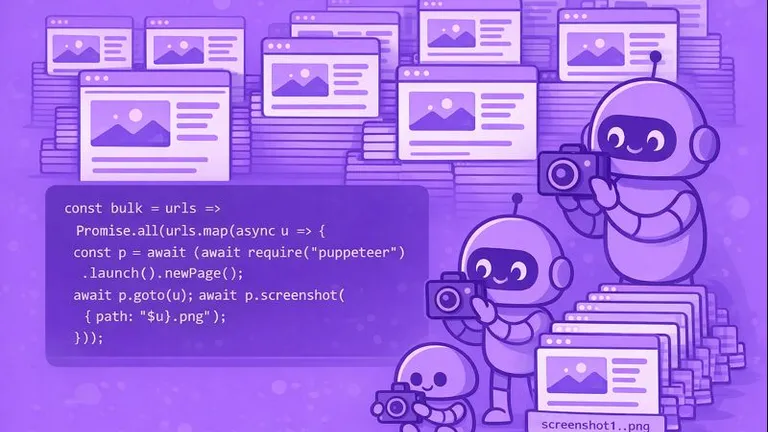
Learn how to take screenshots of multiple URLs with Puppeteer, including concurrency management, error handling, retries, and proxy support.
Exhaustive documentation, ready SDKs, no-code tools, and other automation to help you render website screenshots and outsource all the boring work related to that to us.